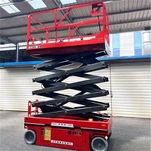

Scissor lifts are among the most widely used aerial work platforms in the world. From warehouse shelves to factory ceilings and construction sites, they carry workers and tools safely to height on a stable, spacious platform. In recent years, electric scissor lifts have become the preferred choice for many operators - quieter, cleaner, cheaper to run and simpler to maintain than ever before. This article explains how electric scissor lifts work and what to consider before choosing one for your site.
An electric scissor lift uses a criss-cross (scissor) mechanism that extends vertically, lifting a large work platform straight up. Power comes from rechargeable batteries that drive the lifting system and, on self-propelled models, the drive wheels. Because the platform moves only vertically, operators get a stable working surface with room for two people and tools, while the compact footprint lets the machine pass through standard doorways and work in narrow aisles.
Working height is the first thing to decide. It should cover your highest task, not just the platform height - on most models the platform stops roughly 1.5 m below the maximum working height. Load capacity matters just as much: count two workers plus tools and materials, and confirm the rated load of the specific model. A typical electric scissor lift handles 300–500 kg, which is enough for most indoor maintenance and picking jobs.
Then consider the environment. Smooth indoor floors suit standard electric scissor lifts perfectly. For outdoor use, choose a model built for the job and check its gradeability - how steep a slope it can climb. Battery-powered electric models now perform well outdoors too, with sealed components and reliable drive systems, and they produce zero exhaust emissions, which makes them welcome in enclosed and indoor-outdoor work spaces.
Safety should never be an afterthought. Look for safety guardrails on all sides, anti-slip platforms and emergency lowering functions. In Europe, mobile elevating work platforms must meet EN 280, and a CE mark confirms the machine has been assessed against the applicable safety requirements. Always train operators, respect rated loads and observe wind-speed limits.
Electric scissor lifts are proven across many settings: high-shelf picking and inventory checks in warehouses; equipment repair, pipeline installation and lighting maintenance in factories; ceiling work and temporary lighting on construction sites; and daily tasks in facilities such as shopping centres and airports. Rental fleets also favour them for simple operation, low running costs and a long service life.
Running costs are a major advantage of electric models. There is no diesel to buy, no exhaust filter to service and fewer moving parts to maintain. Daily checks take minutes - battery level, tyres, guardrails and emergency controls - and routine maintenance is straightforward. Over a machine's working life, an electric scissor lift typically delivers a lower total cost of ownership than a diesel equivalent.
Choosing the right electric scissor lift comes down to matching working height, load capacity and environment to your real tasks. [Huali]'s new electric scissor lift series, covering working heights from [4] to [16] m with rated loads up to [500] kg, is designed for warehouses, factories and construction sites. For detailed specifications or a tailored recommendation, contact our team or visit hualiheavy.com.