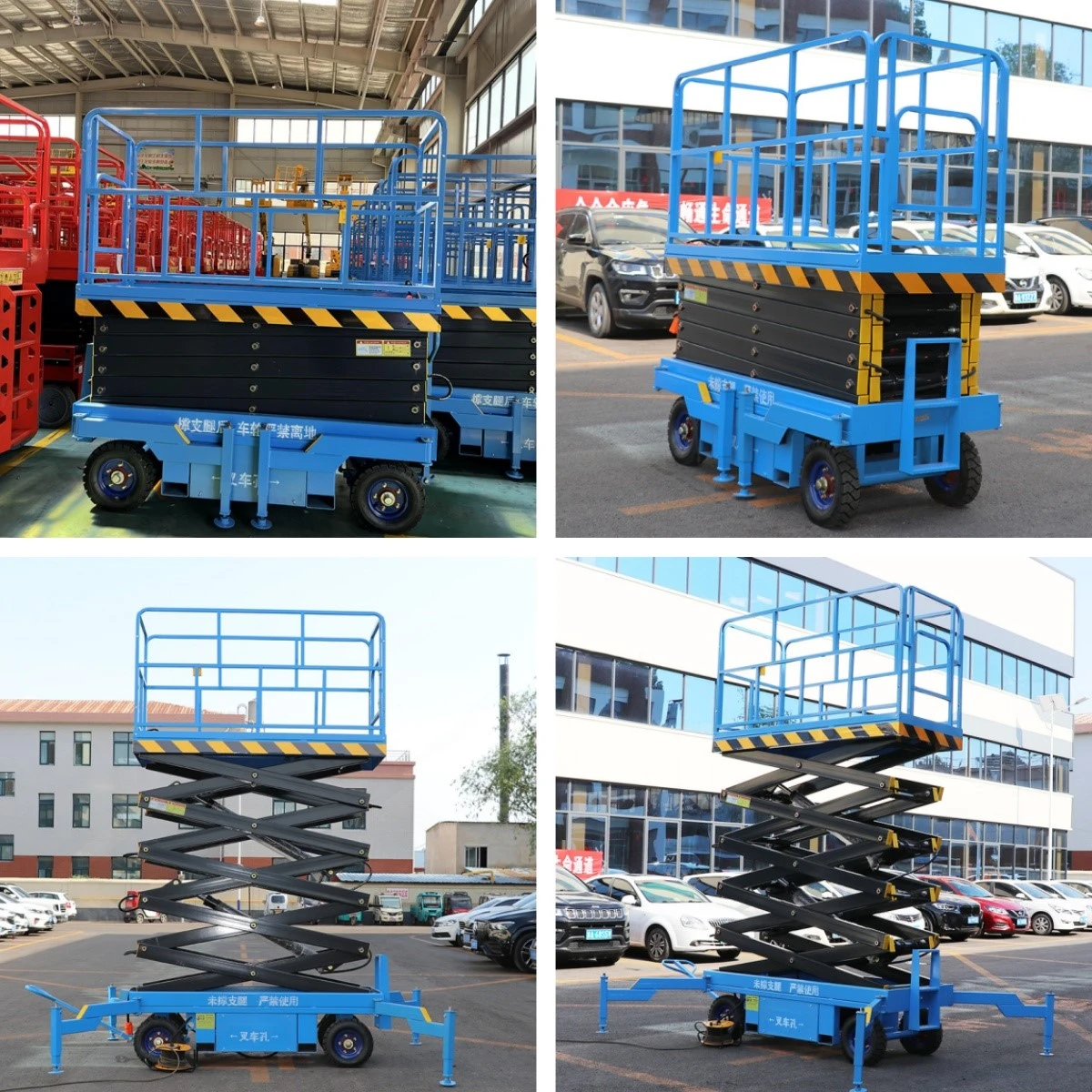

1. Pre-Operation Visual Structural Inspection
Structural damage is the top cause of sudden collapse risks during high-altitude operations. Start with a full walk-around check before powering on the electric scissor lift. First, inspect the scissor arms, pivot pins, and welding seams for cracks, deformation, rust, or loose fasteners. Bent scissor arms or missing pins will directly affect load-bearing stability and trigger tilting accidents.
Next, check the working platform, guardrails, safety gates, and toe boards. Confirm all guardrails are firmly fixed, the platform gate closes and latches tightly, and no parts are loose or damaged. For models with extendable decks, test the stretching and locking function to ensure smooth operation. Meanwhile, verify all safety warning decals and load limit labels are complete and legible, as faded or missing marks easily cause overload operation errors.
Finally, check chassis and wheel conditions. Inspect tires for serious wear, cuts, or under-inflation, and tighten loose wheel nuts. Damaged wheels will cause jitter or offset during driving, greatly reducing scissor lift operational stability.
2. Hydraulic System Key Inspection
Hydraulic system faults are the most common mechanical problems of electric scissor lifts, including oil leakage, insufficient oil pressure, and pipeline blockage. These faults often cause slow lifting, jittery ascent and descent, or sudden platform stalling.
Daily checks focus on three core items. First, check the hydraulic fluid level to ensure it stays within the standard range; insufficient fluid will lead to insufficient power. Second, inspect all hydraulic hoses, joints, and cylinders for oil leakage, aging, or extrusion damage. Even tiny oil drops indicate potential pipeline failure and must be handled in time. Third, clean up dust and debris around the hydraulic system to avoid foreign matter entering and blocking the oil circuit.
3. Electrical System & Battery Safety Check
As the power core of self-propelled electric scissor lifts, the battery and electrical system determine startup safety and continuous operation stability. Daily electrical inspections avoid sudden power failure, electric leakage, or control failure during high-altitude work.
Check the battery appearance first for liquid leakage, shell damage, and electrode corrosion. Clean up white corrosion on battery terminals and ensure all connecting wires are tight without looseness or exposed copper wires. Confirm the battery is fully charged to prevent sudden shutdowns during lifting operations. Then test the control panel, lifting buttons, and walking control functions to ensure sensitive and accurate response, no delay or failure. Finally, check the emergency stop button to guarantee immediate power cut and shutdown in case of emergencies.
4. On-Site Functional Test & Environment Check
Static inspection cannot replace actual operation testing. After completing the above checks, conduct a no-load functional test in a flat, obstacle-free area. Slowly lift and lower the platform multiple times to verify stable operation without abnormal noise, jitter, or stalling. Test forward, backward, and steering functions to ensure flexible and consistent control.
Besides equipment checks, worksite safety assessment is indispensable. Confirm the working ground is flat and solid, avoiding operation on sloped, soft, or uneven ground that may cause tipping. Check overhead spaces for barriers, power lines, and suspended objects to prevent collision accidents. Strictly abide by the rated load capacity, never overload personnel or materials, and comply with site wind speed limits for outdoor high-altitude work.
5. Daily Inspection Log & Fault Handling Rules
Many potential safety hazards accumulate due to unrecorded minor faults. Form a habit of filling in the scissor lift safety inspection log every day, recording inspection time, equipment status, existing minor faults, and processing results. For slight problems such as loose screws and dirty decals, fix them on the spot. For abnormal hydraulic pressure, electrical system failures, or structural damage, mark the equipment as faulty, stop use immediately, and arrange professional maintenance.
This simple rule effectively avoids using faulty equipment and realizes preventive maintenance for aerial lifts, greatly reducing the probability of major safety accidents.
Final Thoughts
Electric scissor lift safety does not rely on emergency response after accidents but on daily standardized inspections. A complete daily inspection checklist takes only 5 to 10 minutes per shift but can eliminate 90% of common aerial work safety hazards. Adhere to pre-use full inspections, standardize operation procedures, and record daily equipment status to protect operator safety, meet industry safety compliance standards, and maximize the service life of electric scissor lift equipment.