
Scissor Lift Total Cost of Ownership: The 2026 Calculation Buyers Get Wrong
The most common TCO error is not arithmetic. It is scope. Buyers calculate the costs they can see on a quote and ignore the costs that arrive eighteen months later.
For a typical facility in 2026, the purchase price of a scissor lift represents only about 40% of the total cost over a five-year period . The remaining 60% is composed of line items that rarely appear in a procurement spreadsheet: annual compliance inspections, battery replacement, charger upgrades, downtime losses, and the utilization shortfall that turns a "cost-saving purchase" into an underused asset.
The following breakdown identifies the four calculation errors that most consistently distort scissor lift TCO in 2026, and what a corrected model looks like for a machine like the HLPT-1416.
Error 1: Treating ANSI Compliance Inspection as Optional or Negligible
ANSI A92.20 requires a documented annual inspection by a qualified technician. Skipping this inspection does not merely risk a citation-it can void liability insurance in the event of an accident . The cost of this inspection runs roughly $300 to $500 annually, covering structural checks and load-sensing calibration .
Buyers who exclude this line item from TCO are understating annual ownership cost by a measurable margin. More importantly, they are modeling a machine that is not legally deployable without the inspection. A TCO calculation that assumes non-compliance is not a conservative estimate-it is an invalid one.
Error 2: Modeling Battery Cost as a One-Time Purchase
For electric scissor lifts, battery replacement is a recurring cost, not a capital expense that disappears after delivery. In the 2026 market, many used and entry-level electric units still rely on deep-cycle lead-acid batteries, which are prone to sulfation if left uncharged over extended periods . Replacing a full set of four 6V batteries costs approximately $800 to $1,200 .
The TCO error is not the battery price itself. It is the assumption that battery life is fixed. A machine charged with a smart charger that prevents overcharging can extend battery life from roughly three years to five . A machine left on a legacy charger will consume two battery sets in the same period. The TCO difference between these two scenarios exceeds the cost of the smart charger by a wide margin.
For buyers specifying lithium-ion configurations, the calculus shifts: higher upfront cost, longer cycle life, and reduced maintenance labor. But the comparison must be run over the same ownership period, not against a lead-acid baseline that assumes optimal charging behavior.
Error 3: Ignoring the Utilization Threshold
TCO models that assume daily use produce flattering numbers. Real-world utilization often does not support that assumption.
The break-even point for scissor lift ownership in 2026 is generally 60 to 80 days of use per year . Below that threshold, the hidden costs of storage, insurance, and battery degradation make ownership more expensive than rental-even when the purchase price looks attractive . Rental rates typically run 2% to 5% of equipment value per month, and for intermittent use, that cost structure aligns better with actual deployment .
For buyers with ongoing maintenance needs, ownership provides on-demand access that avoids delivery and pickup fees associated with rental contracts . But that advantage only materializes above the utilization threshold. A TCO model that assumes 200 days of use for a machine that will actually operate 40 days per year is not a conservative estimate. It is a different machine.
Error 4: Treating Downtime as Zero
Downtime is the cost that never appears in a spreadsheet until it happens. For rental fleet operators, an idle machine generates no revenue while continuing to depreciate. For facility operators, a lift that is out of service during a scheduled maintenance window forces either a rental substitution or a postponed task.
The TCO variables that affect downtime are not mysterious: parts availability, service access, diagnostic capability, and technician familiarity with the machine's systems. A machine with common components and accessible diagnostics spends less time waiting for repair. A machine with proprietary parts and limited service documentation spends more.
This is where specification decisions made at purchase determine TCO years later. The lowest-purchase-price machine is not the lowest-TCO machine if it requires specialist service that is not locally available.
Applying the Corrected Model to the HLPT-1416
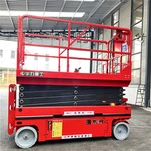
The HLPT-1416 is an electric scissor lift with a 16 m working height and 230 kg capacity, configured for indoor and narrow-aisle applications. A corrected TCO model for this machine would include:
Annual ANSI inspection: $300–$500, non-negotiable for compliant operation .
Battery replacement reserve: For lead-acid configuration, $800–$1,200 per replacement cycle, with cycle length determined by charging discipline . For lithium configuration, higher upfront cost offset by longer cycle life and reduced service labor.
Utilization assumption: Honest assessment of annual operating days. Below 60–80 days, rental should remain in the comparison set .
Downtime provision: Estimated from parts availability and service network coverage in the destination market. Buyers should ask for documented service intervals and parts lead times, not generic assurances.
HuaLi supplies the HLPT-1416 with configuration documentation that supports this level of TCO modeling, including battery specification, service interval data, and compliance inspection requirements matched to the destination market. Contact us with your utilization profile and ownership period for a model-specific TCO projection.