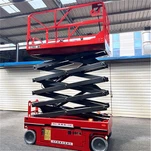

Articulating boom lifts, also known as knuckle boom cranes, extend their worker platforms by unfolding multiple hinged sections of their hydraulic booms, like an old-fashioned folding ruler or a pantograph.
Maneuverability
Because of the flexibility of their joints, articulating booms can maneuver a work platform into tight spaces, including up and over obstacles such as tree branches, vehicles, low buildings, and girders, and under gym ceilings, air ducts, bridges, and utility lines. Virtually all lifts can rotate their turret, but articulated models that can also rotate their platform and jib can bring workers up to even more difficult-to-access jobs at height.
Height & Capacity
Although articulating lifts are more dexterous than telescoping boom lifts, they generally can't lift as much weight or reach as far horizontally. A typical articulated boom lift might have an unrestricted (fully extended) lift capacity of 500 pounds (227 kilograms), a horizontal outreach of 25 feet (7.6 meters), and a vertical platform height of 45 ft (13.7 m).
Because one or two workers can stand on the platform to perform their work, a boom lift's work height is said to be the platform height plus 6 ft (1.8 m). Note that many articulated boom lifts have a telescopic upper boom for greater height and reach.
Boom lifts of all types may come with safety features such as obstacle detection around the work platform, tilt sensors and alarms, and motion beacons with audible alerts. Popular options include air, water, and power lines to the platform that allow workers to use tools or clean building fascias.